Filters
Filters are used to separate the components of a signal on a wavelength
basis. In the field of electrical engineering, frequency rather than wavelength
is the basis for filtering. In surface metrology, wavelength is the basis
of filtering as it can be related to the part being measured. A filter operates
a waveform, such as a primary profile, to produce the required
output. In order to separate out the roughness
and the waviness,
a cutoff wavelength ( c) is set. Filters operate depending on the cutoff set for them.
ASME and ISO standards provide a series of cutoffs (0.08, 0.25, 0.8,2.5,
8 mm). All wavelengths below
c in the profile fall into the
roughness
regime and all others go into the waviness and
form
regime. Similarly, waviness
and form
can also be separated by setting a cutoff wavelength (
f). . In addition to
c and lf it is also possible to set a short wavelength cutoff
s. This cutoff assures a well-defined bandwidth for roughness
(
s -
c). The value of
s is chosen based on a ratio of
c/
s to be either 100, 300, or 1000. The radius of the stylus used to trace
the profile is expected to be smaller than
s. The use of
s effectively eliminates one of the variables that could
affect the comparison of parameters from different commercial vendors of stylus
instruments. This is done by calculating the parameters based on a well-defined
bandwidth (
s-
c).
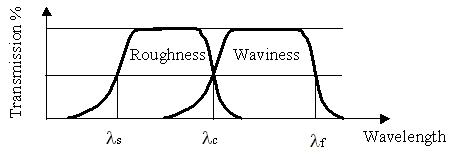
Figure 1. Transmission characteristic of roughness and waviness profiles
References
Surface Texture (Surface Roughness, Waviness, and Lay), an American
National Standard, ASME B46.1-2002, New York, NY